
What is the Carthusian Horse
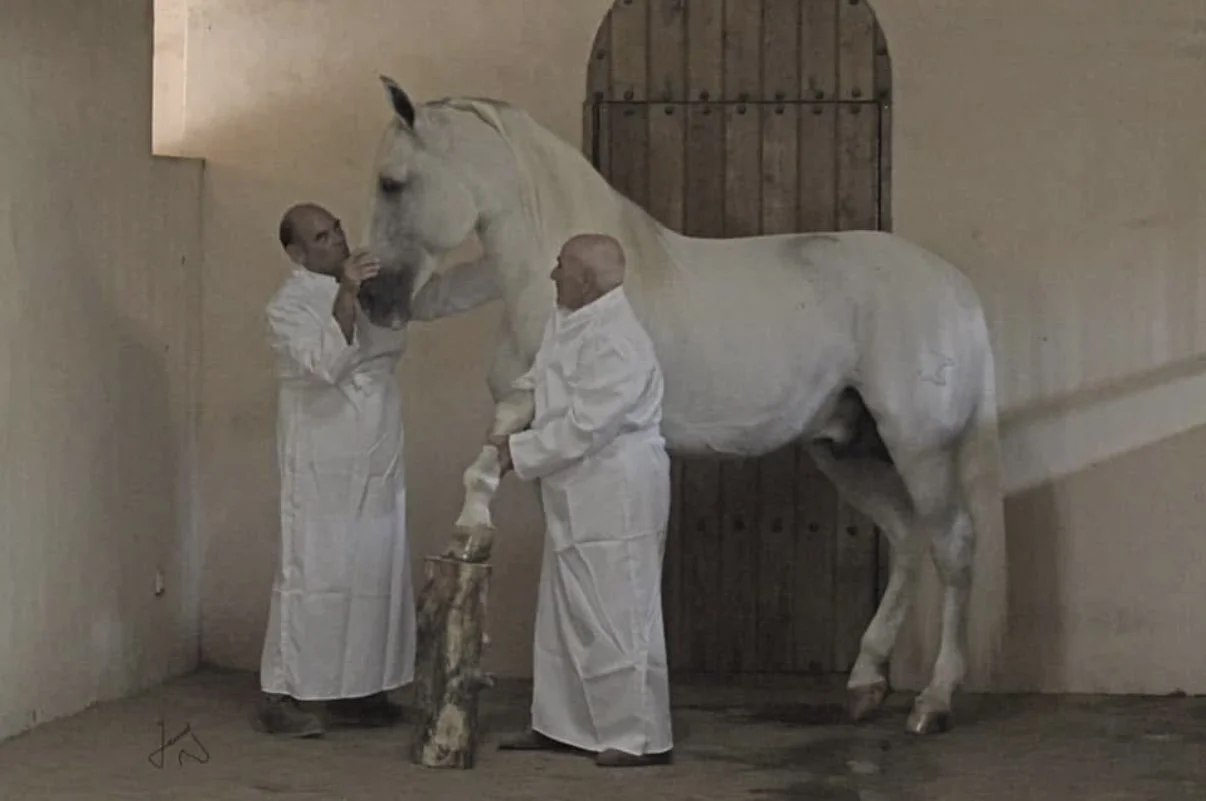
The Carthusian, or Cartujano, horse traces its history to the Carthusian monastery of Santa María de la Defensión in Jerez de la Frontera, Andalusia, where the monks established their horse-breeding tradition that would become an enduring legacy..
In 1484, the monks undertook the deliberate breeding of horses from Andalusian mares of the surrounding region. Guided by intuition, intention, and prayer, the monks developed this bloodline through successive generations.
This was breeding on a profoundly different timescale from that of the modern world. Their work was measured not in years, but in generations. They observed their horses throughout their lives and maintained careful records; retaining and breeding those that best embodied the qualities they sought, and repeated the process throughout generations. Through this patient process of selection, they progressively refined a distinct type of Spanish horse; one characterized by beauty, harmony, nobility, intelligence, character and an unmistakable quality of presence.
The importance of this work is made even clearer by the fact that the breeding stock remained under the care of the single institution for approximately 326 uninterrupted years, from 1484 until 1810. For more than three centuries, the Carthusian monks themselves were the custodians, breeders and arbiters of this bloodline. During this time, the horses were protected from the external influences that so often reshape a breed. The monks could continue selecting according to their own ideals, generation after generation, creating a population that became increasingly distinct.
In 1810, the survival of the Carthusian horses was suddenly placed in jeopardy by the arrival of French troops during the Peninsular War. With the monastery and its livestock threatened, the monks arranged for D. Pedro José Zapata Caro, a priest and prominent local livestock breeder who was a friend of the prior, to acquire a group of the mares and stallions.
For the next two centuries, the Carthusian horses passed through the hands of a relatively small number of breeders and families who dedicated themselves to continued preserving the stock. The lineage repeatedly faced the possibility of dispersal, dilution or disappearance, yet portions of the original breeding population continued to be protected.
By the twentieth century, the surviving Carthusian horses had become recognized as something exceptionally rare; a population carrying the legacy of centuries of deliberate selection under the Carthusian monks, followed by generations of breeders who understood that they were custodians of something that could not simply be recreated once lost.
The significance of this lineage is not simply the rarity of an old pedigree. It is the rarity of a specific breeding tradition, carried forward from the monastery at Jerez and preserved through generations of people who understood the value of maintaining what the monks had created.
The Carthusian monks did not merely leave behind old horses. They left behind a living remnant of a breeding program that began more than five centuries ago, under a single uninterrupted breeding philosophy, shaped by intuition, intention, and patience.
This is what makes the Cartujano so extraordinary; and is why I am so passionate about preserving and protecting this bloodline for future generations.